Many apps and devices quietly shape your routines: they save you time with personalized automation, they can collect your data and create privacy and surveillance risks, and they often nudge choices you believe are purely yours, so you get convenience, hidden influence, and potential danger all at once.
Key Takeaways:
- AI personalizes everyday experiences-recommendations, search results, ads, and assistant suggestions adapt to your habits so decisions feel effortless.
- AI runs routine background tasks-email sorting, calendar scheduling, home energy and device management, fraud detection, and system maintenance operate invisibly to save time.
- AI subtly shapes behavior and environments-adaptive interfaces, targeted notifications, real-time translation, and content moderation steer what you see and how you act.
Smart Assistants: Your Everyday Helpers
Devices like Amazon Alexa (launched 2014) and Google Assistant (2016) quietly automate chores you used to do manually: setting timers, controlling lights, reading messages and routing calls. You rely on routines that bundle actions-morning brief, commute updates, and grocery lists-so tasks finish faster. With over 100,000 Alexa Skills and compatibility with tens of thousands of smart devices, these assistants deliver major convenience while also posing clear privacy trade-offs.
Voice-Activated Convenience
When you say a wake word, the assistant executes multi-step commands hands-free-turning on Philips Hue lights, adjusting a Nest thermostat, and adding milk to your shopping list in one go. Many users cut prep time: simple routines can shave several minutes off daily tasks. Integration with services like Uber, Spotify and calendar APIs means your voice can book a ride or queue a playlist without touching a screen, increasing accessibility and speed.
Personalization and Learning
Your assistant builds a profile from calendars, search history and device use to tailor responses: traffic alerts for your commute, prioritized email summaries, or suggested recipes based on past orders. Voice match features can recognize up to six different users, so recommendations and reminders become personal. This learning improves convenience but also concentrates sensitive signals that you should monitor.
Under the hood, models run both in the cloud and increasingly on-device (via on-device speech recognition and tinyML), reducing latency and limiting how much audio is sent off your gadget. You see this in Siri Shortcuts, Google Routines and Alexa Routines that predict actions-like preheating your oven when you start a cooking routine-based on patterns. Enterprises report double-digit engagement lifts from personalized prompts, yet you should weigh those gains against how long voice logs are stored and who can access them.
AI in Social Media: Connecting You Seamlessly
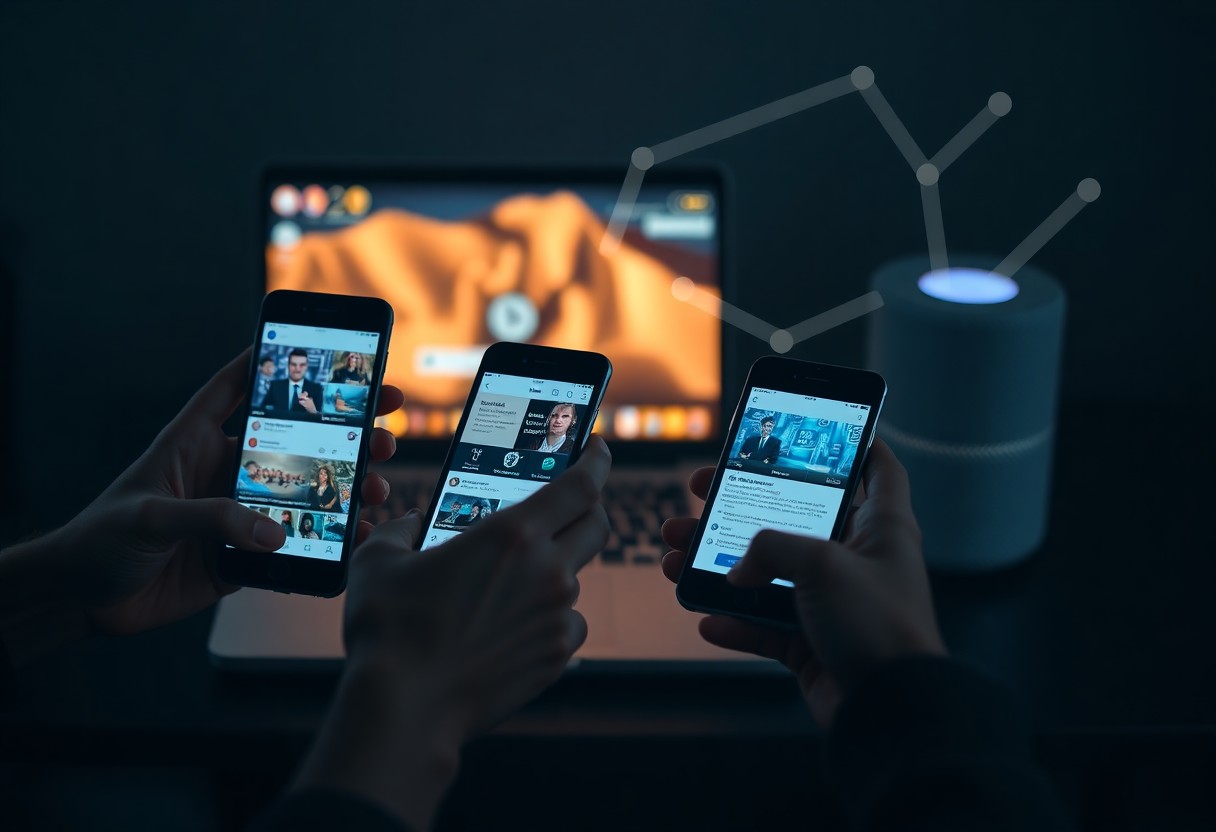
Behind the scenes, algorithms curate what you see: YouTube attributes over 70% of watch time to recommendations, and platforms analyze billions of signals daily – likes, watch time, follows, location – to serve posts that match your predicted interests. That helps you discover niche creators quickly, boosts engagement, and simultaneously accelerates misinformation and echo chambers, a trade-off you often don’t notice.
Tailored Feeds and Recommendations
Recommendation engines combine collaborative filtering, content embeddings, and reinforcement learning to adapt within minutes to your behavior; TikTok-style systems can surface viral clips after a few seconds of interaction. Personalization commonly increases engagement by an estimated 20-50% (clicks or watch time), so you see more of what hooks you – and less that challenges your views.
Enhancing Communication
AI powers auto-generated captions, inline translations, voice-to-text, and suggested replies so you can respond faster and bridge language gaps; WhatsApp’s end-to-end encryption protects roughly 2 billion users, while classifiers filter spam and abuse to keep conversations smoother. These features speed interaction and accessibility, but automated moderation and translation errors can also distort context and intent.
For example, Twitter’s Community Notes pairs human contributors with models to surface context for misleading tweets, and Google’s Smart Reply and Smart Compose suggest replies that save seconds per message, cumulatively speeding communication at scale. At the same time, sentiment-analysis and emotion-detection tools enable hyper-targeted ads and mood-based nudges, posing significant privacy and ethical risks you should be aware of.
Shopping with AI: A Personalized Experience
Shopping has quietly become hyper-personalized: AI analyzes your clicks, purchase history and even images to recommend items, tailor promotions and predict what you’ll want next; What’s the most surprising way AI has become part of your life? shows how common this feels, and estimates suggest recommendations can account for up to 35% of e-commerce sales, with a trade-off in data and pricing transparency.
Product Recommendations
Recommendations use collaborative filtering, session signals and images to surface items you’re likely to buy, showing tailored bundles, timely upsells and dynamic discounts; retailers report these systems can lift average order value and conversion, with behavioral signals such as dwell time and repeat views driving the most accurate matches, so you see fewer irrelevant listings and more items that fit your tastes.
Virtual Try-Ons
Virtual try-ons use AR and computer vision so you can preview clothes, glasses or makeup on your own face or room before buying, and some retailers report conversion uplifts of 20-40% and returns dropping substantially, making the experience both convenient for you and cost-saving for sellers.
Under the hood, these tools combine 3D body modeling, pose estimation and texture mapping; LiDAR-enabled phones and improved monocular depth models boost accuracy, while size-fit algorithms match your measurements to SKUs-brands like IKEA, Warby Parker and Sephora run A/B tests showing higher purchase confidence, but the same data that improves fit can expose sensitive body and preference signals unless you control sharing settings.
Health and Wellness: AI for a Healthier Life
AI now underpins the devices and apps shaping your health choices, turning continuous sensor data into early warnings and personalized plans; the Apple Heart Study enrolled 419,000 participants to validate irregular pulse notifications, and the Apple Watch ECG earned FDA clearance, showing how consumer signals reach clinical pathways. You get trend-based insights that flag issues long before a single clinic visit.
Fitness Trackers and Wearables
Wearables collect heart rate, steps, sleep, HRV and SpO2, while onboard AI translates that into tailored workouts, recovery advice and VO2‑max estimates; many devices now include fall detection and AFib alerts, and studies using wearables have accelerated arrhythmia diagnosis. You receive adaptive coaching and nudges so training and rest adjust automatically when stress or poor sleep appears.
Mental Health Apps
AI chatbots and therapy apps deliver CBT techniques, mood tracking and crisis triage; a small randomized trial (~70 participants) of an AI chatbot showed reduced depressive symptoms after two weeks. You can access conversational support anytime, but evidence, oversight and safety features vary, and these apps are not a replacement for emergency care.
Beyond chat, hybrid models combine AI screening with human therapists or coaches-companies like Ginger and Wysa scale access and shorten wait times by routing higher-risk users to clinicians. You should verify whether an app is HIPAA-covered and review its data-sharing policy, since many consumer tools lack full healthcare privacy protections; sustained benefit often depends on integration with human care and consistent engagement.
Home Automation: Making Life Easier
Smart Home Devices
You rely on smart speakers, locks, lights and cameras to shave seconds off daily tasks: voice commands turn lights on, August-style locks let you grant temporary access, and Philips Hue schedules mimic occupancy. Many devices run local routines and cloud skills that tie together multiple brands, so your morning coffee and thermostat adjustments trigger automatically. Be aware that while these conveniences save time, they also introduce security risks – for example, the Mirai botnet (2016) exploited unsecured cameras to launch large DDoS attacks.
Energy Management
You cut bills and peak demand by handing HVAC control to smart thermostats and load-shifting devices; manufacturers like Nest report average savings of 10-12% on heating and 15% on cooling. Time-of-use settings let you run washers or EV charging when rates are lowest, and smart plugs track appliance-level consumption so you can stop phantom loads that quietly add up.
Beyond basics, you can pair solar arrays with a battery – for example, a Tesla Powerwall stores about 13.5 kWh to cover evening usage or ride out outages – while utilities run demand-response programs that temporarily adjust many thermostats to shave peak load. In practice, households using adaptive schedules and real-time pricing often shift 1-3 kWh of discretionary usage to off-peak hours, lowering bills and reducing grid strain. However, this visibility into your usage creates privacy vectors: detailed energy data can reveal occupancy patterns, so encrypting telemetry and vetting vendor data practices is a high-impact step you should take to protect your home.
Transportation: AI on the Move
Navigation and Traffic Management
Adaptive signal systems like SCOOT and SCATS and apps such as Google Maps and Waze analyze live GPS and sensor feeds to reroute millions daily; as a result, you can see your commute drop by 10-30% during peak hours. Cities use traffic datasets from INRIX and TomTom to time lights and prioritize buses, and pilots in Los Angeles and Barcelona showed reduced idling, lower emissions and improved bus punctuality when corridors were optimized.
Autonomous Vehicles
Waymo’s robotaxi program in Phoenix and San Francisco, Cruise pilots and Tesla’s Autopilot beta mean you may already share streets with automated systems; these platforms combine cameras, radar and lidar and have logged extensive testing, yet safety investigations and edge-case failures persist. Regulators like the NHTSA continue to probe incidents while operators expand geofenced services to limit risk as they scale.
Autonomous stacks fuse sensor layers-cameras, lidar (detecting objects at 200-250 m), radar and high-definition maps-and train on billions of simulated miles to handle rare scenarios; this helps reduce human-error crashes (involved in about 94% of collisions), but sensor occlusion and unpredictable pedestrians remain top failure modes. Industry focus on V2X communications, redundant systems and strict geofencing aims to make deployments safer and more reliable for your daily trips.

Summing up
Hence you already live with AI shaping many small choices-your playlists, commute, shopping suggestions, and smart-home routines-making daily tasks faster, more personalized, and often invisible. As AI learns your preferences, you gain convenience, time, and tailored experiences while staying in control of which tools you let into your life.
FAQ
Q: How does AI personalize the content and services I use every day without me noticing?
A: AI analyzes your interactions-searches, clicks, watch time, shopping history-and uses models to predict what will keep you engaged or be useful. Recommendation engines rank videos, products, news and social posts to match inferred preferences; search engines reorder results based on past behavior and context; email and messaging clients prioritize or summarize messages. Many apps run continual A/B tests and adjust interfaces in real time, so the version you see has been optimized by algorithms. These systems rely on feature extraction, collaborative filtering and deep learning to surface content tailored to your habits without explicit input.
Q: In what ways is AI operating in the background of my devices and home?
A: On-device and cloud AI manage performance and convenience tasks: battery and resource optimization, predictive text and autocorrect, camera scene detection and photo enhancement, noise suppression in calls, and smart routing in navigation apps. Smart-home devices use voice recognition, occupancy sensing and predictive schedules to adjust heating, lighting and security. Modern cars use driver-assist systems-lane-keeping, adaptive cruise control and collision alerts-that process sensor data continuously. Many of these functions run locally (edge AI) for speed and privacy or in the cloud for heavier computation, so the behavior feels seamless rather than overtly “powered by AI.”
Q: How does AI affect my privacy, security and the unseen decisions that shape my options?
A: AI-driven systems build profiles from aggregated signals to detect fraud, flag suspicious activity, and screen content automatically, which can improve safety but also lead to opaque decisions about access or visibility. Targeted advertising and dynamic pricing use segmentation and propensity models to show different offers to different users. Automated moderation and hiring tools filter or rank content and candidates based on learned patterns, sometimes amplifying biases present in training data. You can limit exposure by reviewing app permissions, checking ad and privacy settings, using privacy-focused tools or opting out of certain data uses where platforms provide that option.